
Class 8 Antonym English Worksheet Using Context
Class 8EnglishEnglish GrammarFree DownloadPDF

Shubham ShuklaVisit Profile
I am a dedicated educator and public speaking expert with over 2 years of experience in teaching and recruitment. Currently associated with PlanetSpark, I specialize in helping students develop strong communication skills and confidence. Alongside this, I teach senior classes at Surya Academy, where I focus on making learning engaging and meaningful for every student.
Class 8 Antonym English Worksheet Using Context
Class 8EnglishEnglish GrammarFree DownloadPDF
Shubham ShuklaVisit Profile
I am a dedicated educator and public speaking expert with over 2 years of experience in teaching and recruitment. Currently associated with PlanetSpark, I specialize in helping students develop strong communication skills and confidence. Alongside this, I teach senior classes at Surya Academy, where I focus on making learning engaging and meaningful for every student.
Opposites in Action: Context-Based Antonym Practice for Grade 8
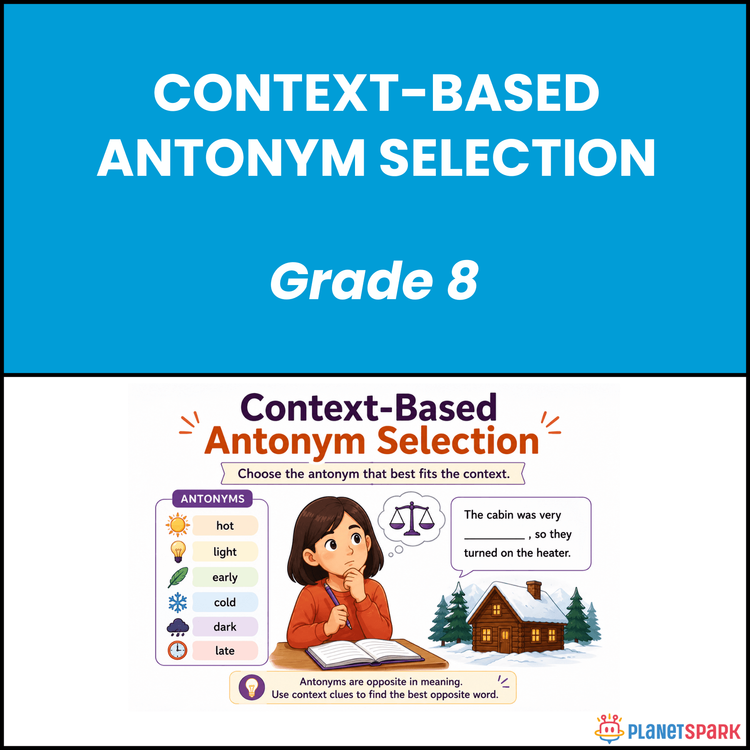
This Grade 8 worksheet helps students strengthen vocabulary and comprehension skills by practicing antonyms in meaningful contexts. Learners explore opposite meanings through engaging grammar activities that improve reading fluency, contextual understanding, and expressive writing.
Why Antonyms Matter in Grammar?
Understanding antonyms helps students build stronger vocabulary and sentence comprehension. For Grade 8 learners, this topic is important because:
1. Antonyms help readers understand contrast and meaning.
2. Context clues support accurate vocabulary selection.
3. Opposite words strengthen reading comprehension skills.
4. Vocabulary variety improves writing fluency and creativity.
5. Antonyms help students communicate ideas more clearly.
What’s Inside This Worksheet?
This worksheet includes five engaging grammar and vocabulary exercises that build antonym recognition and contextual understanding:
🧠 Exercise 1 – Multiple Choice Questions
Students identify the best antonyms for highlighted vocabulary words using sentence context and meaning clues.
✏️ Exercise 2 – Fill in the Blanks
Students complete sentences using antonym-related vocabulary such as peacefully, hopelessly, joyfulness, and nervously.
📋 Exercise 3 – True or False
Learners review statements about antonyms, context clues, contrast, and vocabulary understanding.
📝 Exercise 4 – Underline the Noun and Circle the Verb
Students identify nouns and verbs in complete sentences while strengthening grammar awareness.
💡 Exercise 5 – Sentence Writing
Students create original sentences using opposite-meaning vocabulary and emotional language.
✅ Answer Key (For Parents & Educators)
Exercise 1 – Multiple Choice Questions
1. cheerful
2. truthful
3. gloomy
4. serious
5. hopeful
6. peaceful
7. fearless
8. delighted
9. patiently
10. joyful
Exercise 2 – Fill in the Blanks
1. gloominess
2. nervously
3. fearfully
4. thankfully
5. doubtfully
6. carelessly
7. peacefully
8. cheerfully
9. joyfulness
10. hopelessly
Exercise 3 – True or False
1. True
2. True
3. True
4. True
5. True
6. False
7. False
8. True
9. True
10. True
Exercise 4 – Choose the antonym of the highlighted word.
1. ignored
2. abandoned
3. discouraged
4. scattered
5. repelled
6. lazily
7. criticized
8. neglected
9. carelessly
10. confusingly
Exercise 5 – Sample Sentence Answers
1. The audience felt cheerful after the performance.
2. Riya gave a truthful answer during the debate.
3. The bright classroom looked peaceful in the morning.
4. Raj sounded serious during the meeting.
5. The story ended on a hopeful note.
6. Meera remained peaceful before the examination.
7. The fearless captain led the team confidently.
8. The teacher felt delighted after the successful project.
9. Students waited patiently near the gate.
10. The poem created a joyful feeling among readers.
Boost your child’s vocabulary confidence with exciting antonym activities that make reading, writing, and comprehension more powerful and engaging.
How does this antonym worksheet help Grade 8 students? This worksheet helps students understand opposite meanings through context clues, improving vocabulary, reading comprehension, and sentence-building skills.
Why are antonyms important in vocabulary learning? Antonyms help students recognize contrast in language, improve comprehension, and strengthen communication by understanding opposite meanings accurately.
What activities are included in this context-based antonym worksheet? The worksheet includes multiple choice questions, fill-in-the-blanks, true or false, grammar identification, and sentence-writing exercises focused on antonyms and contextual vocabulary.
Frequently Asked Questions
Antonyms are words with opposite meanings, and they help Class 8 students expand vocabulary and improve language accuracy.
Many learners focus only on word meaning instead of using sentence context to understand the correct opposite word.
Antonym exercises help students recognize contrast, understand meaning changes, and develop stronger comprehension strategies in English worksheets.