
Class 5 Quotation Marks Dialogue English Grammar Worksheet

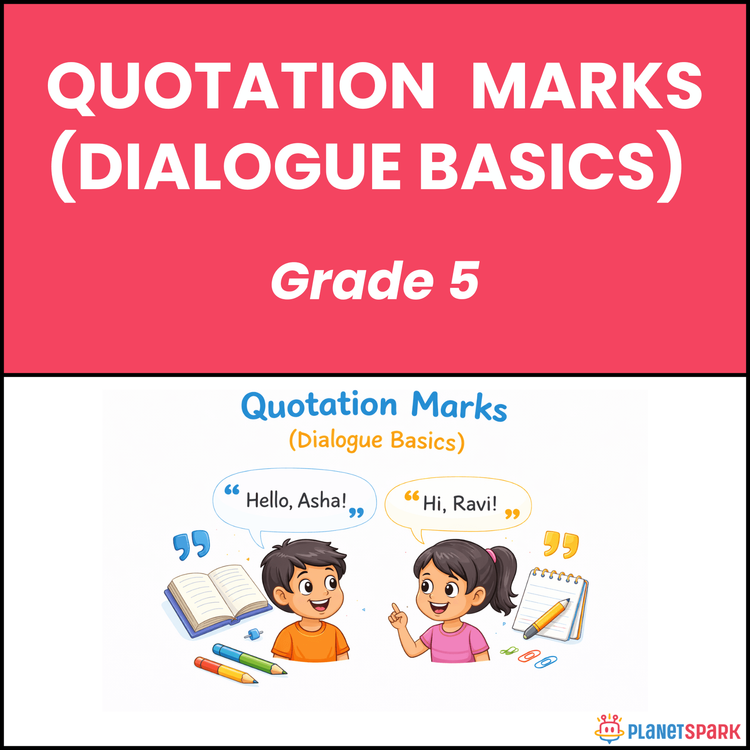
Class 5 Quotation Marks Dialogue English Grammar Worksheet
Talking with Clarity: Quotation Marks for Dialogue Worksheet for Grade 5
This Grade 5 worksheet helps students learn how quotation marks are used to show spoken words in sentences and dialogues. Through engaging grammar activities, students practise identifying, correcting, and writing sentences with proper quotation marks. The worksheet focuses on dialogue basics so learners understand where to place quotation marks when someone is speaking.
Designed especially for Grade 5 learners, this worksheet uses relatable school conversations and everyday situations to make punctuation practice meaningful. Students work through multiple-choice questions, true or false tasks ,fill-in-the-blank dialogue sentences, sentence rewriting, and a paragraph activity. These exercises help students understand how quotation marks make conversations clear and grammatically correct.
Why Quotation Marks Matter in Grammar?
Quotation marks help show the exact words someone says. For Grade 5 learners, this topic is important because:
1.They clearly show spoken dialogue in sentences.
2.They help readers understand who is speaking.
3.They improve punctuation accuracy in writing.
4.They make storytelling and conversations easier to read.
What’s Inside This Worksheet?
This worksheet includes five grammar-rich activities that build fluency with quotation marks:
Exercise 1–Choose the Correct Sentence
Students select the sentence that correctly uses quotation marks to show dialogue .Example: “Ravi said ,"Hello, Meera."”
Exercise 2–True or False
Students decide whether the quotation marks in each sentence are used correctly.
Exercise 3–Fill in the Blanks
Students complete short dialogue sentences by filling in one suitable word inside quotation marks.
Exercise 4–Sentence Rewriting
Students replace one word in each sentence using vocabulary from a word bank related to dialogue and speaking.
Exercise 5–Paragraph Writing with Quotation Marks
Students read a classroom story and add quotation marks in the correct places to show spoken dialogue
.Answer Key(For Parents & Educators)
Exercise 1–Choose the Correct Sentence
1.Ravi said, "Hello, Meera."
2.Meera asked, "Where is the bus?"
3.Riya said ,"I will play today."
4.Asha said, "Good morning, Raj."
5.Raj asked, "Will it rain today?"
6.The coach said, "Run fast now."
7.Anu said ,"I like mangoes."
8.The teacher said ,"Open your books."
9.Mother asked, "Where is Riya?"
10.Rahul said, "I finished my homework."
Exercise 2–True or False
1.True 2.True 3.True 4.True 5.True 6.False 7.True 8.False 9.False 10.False
Exercise 3–Fill in the Blanks
1.This
2.Where
3.today
4.my
5.tomorrow
6.fast
7.your
8.music
9.ready
10.sunny
Exercise 4–Sentence Rewriting
1.Asha said she would read the first sentence.
2.Meera told the class to be a good listener.
3.Riya read a famous quotation from the storybook.
4.Ravi answered when the teacher asked him something.
5.The students practised dialogues in English class.
6.Raj spoke when the teacher called his name.
7.The teacher asked a question during the reading activity.
8.Meera wrote a full sentence on the board.
9.The class practised short dialogues during English period.
10.Riya enjoys speaking during dialogue practice.
Exercise 5–Paragraph Writing(Add Quotation Marks)
"Today we will read a conversation together."
"I would like to start the reading."
"I will read the next line."
"This story is quite interesting."
"Acting in class is always fun."
"You all spoke very clearly today."
"I enjoyed reading the dialogue today."
"You all listened carefully and worked well together."
Encourage your child to speak and write confidently by mastering dialogue punctuation and communication skills with expert-guided English learning at Planet Spark.
Frequently Asked Questions
Quotation marks show the exact words someone says in a sentence, an important dialogue rule.
They clearly separate spoken words from the rest of the sentence in English dialogue writing.
Practice helps learners place quotation marks correctly in conversations and improve writing skills.