
Class 5 Worksheet on Commas with Introductory Clauses

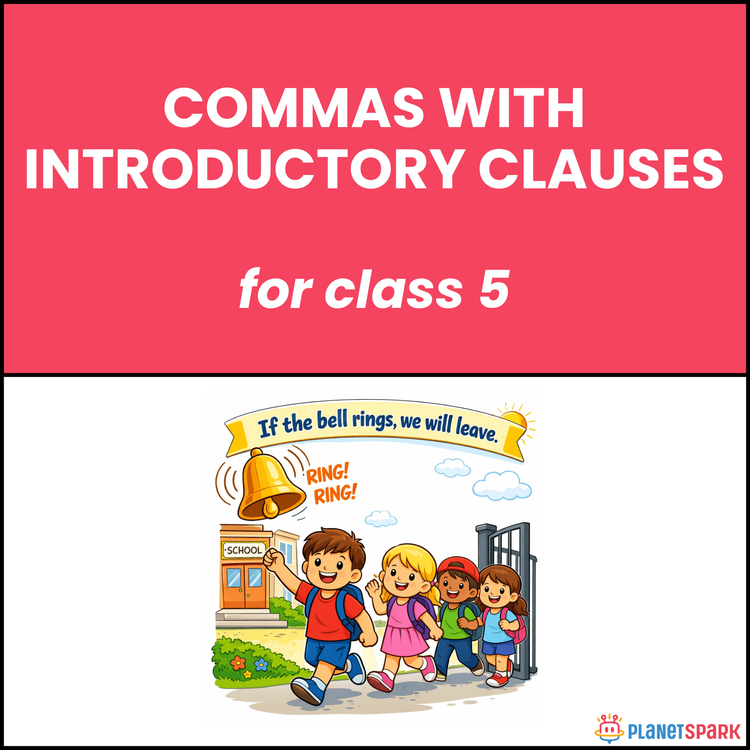
Class 5 Worksheet on Commas with Introductory Clauses
Clause Connect: Mastering Commas with Introductory Clauses for Class 5
This Grade 5 worksheet helps students understand how to use commas after introductory clauses—phrases that come at the beginning of a sentence and set the context. Through engaging and structured exercises, learners build strong sentence clarity and punctuation skills.
Why Commas with Introductory Clauses Matter in Grammar?
Introductory clauses help add context and meaning to sentences. For Grade 5 learners, this topic is important because:
1. It helps organize ideas clearly in a sentence.
2. It prevents confusion by separating introductory information.
3. It improves sentence flow and readability.
4. It strengthens writing and editing skills.
What’s Inside This Worksheet?
This worksheet includes five grammar-rich activities that build confidence in punctuation:
🧠 Exercise 1 – Multiple Choice Questions
Students choose the correctly punctuated sentence, focusing on placing a comma after the introductory clause.
✔️ Exercise 2 – True or False
Students identify correct comma usage after introductory clauses, strengthening conceptual understanding.
✏️ Exercise 3 – Add the Comma
Students insert commas correctly after introductory clauses in sentences.
🔄 Exercise 4 – Sentence Rewriting
Students rewrite sentences by adding commas correctly after introductory clauses.
📝 Exercise 5 – Paragraph Writing
Students rewrite a paragraph by inserting commas correctly after introductory clauses, applying their learning in context.
This worksheet, based on the uploaded PDF :contentReference[oaicite:0]{index=0}, builds from recognition to real-life application for strong grammar mastery.
✅ Answer Key (For Parents & Educators)
Exercise 1 – Multiple Choice
1. b 2. c 3. a 4. b 5. c 6. a 7. b 8. a 9. c 10. a
Exercise 2 – True or False
1. False
2. True
3. False
4. False
5. False
6. True
7. True
8. True
9. False
10. True
Exercise 3 – Add the Comma
1. When the rain stopped, the children ran outside.
2. After the teacher finished the lesson, the class became quiet.
3. If you listen carefully, you will understand the topic.
4. Because the road was slippery, the driver slowed down.
5. While the music played, the audience clapped along.
6. Before the test began, students revised their notes.
7. Although she was nervous, she spoke confidently.
8. When the clock struck twelve, everyone cheered loudly.
9. If the team wins today, they will reach the finals.
10. After the guests arrived, we served dinner quickly.
Exercise 4 – Rewritten Sentences
1. While the storm raged, the sailors stayed calm.
2. Because the baby was crying, the mother rushed inside.
3. Before the guests arrived, we cleaned the house.
4. If the lights flicker, call the electrician immediately.
5. After the train departed, the station became quiet.
6. When the cake was ready, we decorated it nicely.
7. Although the road was narrow, the driver moved carefully.
8. If the phone rings, answer it quickly.
9. Before the sun sets, birds return to their nests.
10. While the match continued, fans cheered loudly.
Exercise 5 – Paragraph Writing (Corrected Version)
Last week we visited a science fair with our classmates. When we entered the exhibition hall, we noticed many colorful displays. As we moved to the first section, we saw robots performing simple tasks. After we explored the robotics area, the guide explained how machines follow instructions. While we observed the experiments, students asked thoughtful questions. Because the projects were creative, everyone felt excited and curious. If we pressed certain buttons, the models started working immediately. Although the hall was crowded, we managed to see every exhibit. Before we left the fair, we thanked the organizers for their efforts. When the trip ended, we returned to school with new ideas and experiences.
Help your child write smoother, clearer sentences by mastering introductory clauses and punctuation step by step.
Frequently Asked Questions
Commas are placed after introductory clauses to separate them from the main clause, like "After school, I went home."
They forget to place a comma after the introductory clause, making the sentence harder to read.
Use short sentences with clear introductory phrases and have them practice by reading aloud.