
Class 6 Antonyms with Multiple Meanings Worksheet

Class 6 Antonyms with Multiple Meanings Worksheet
Meaning Matters: Antonyms with Multiple Meanings for Class 6
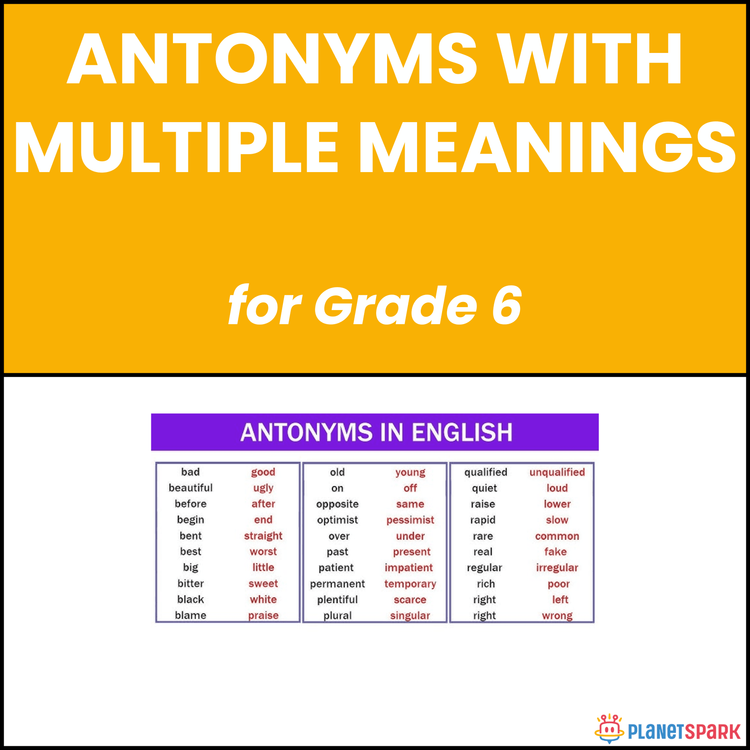
This Grade 6 worksheet focuses on understanding antonyms based on context, especially for words with multiple meanings like light, right, and hard. Students learn how the meaning of a word changes depending on usage, helping them choose the correct opposite word in real-life situations.
Why Contextual Antonyms Matter in Grammar?
Some words have multiple meanings, and their opposites depend on how they are used. For Grade 6 learners, this topic is important because:
1. It improves vocabulary through context-based understanding.
2. It strengthens reading comprehension and interpretation skills.
3. It develops critical thinking and word analysis abilities.
4. It enhances sentence accuracy and communication clarity.
What’s Inside This Worksheet?
This worksheet includes five structured exercises designed for practical grammar application:
Exercise 1 – True or False
Students identify whether the antonym used is correct based on context.
Exercise 2 – Sort the Words
Students classify word pairs into antonyms and not antonyms based on contextual meaning.
Exercise 3 – Fill in the Blanks
Students choose the correct antonym from given pairs to complete sentences.
Exercise 4 – Multiple Choice Questions
Students select the correct antonym based on sentence meaning.
Exercise 5 – Sentence Rewriting
Students rewrite sentences by replacing highlighted words with correct antonyms.
Answer Key (For Parents & Educators)
Exercise 1 – True / False
1. True
2. True
3. False
4. True
5. True
6. False
7. False
8. True
9. False
10. False
Exercise 2 – Sort the Words
Antonyms:
light/heavy
light/dark
hard/soft
sharp/blunt
close/far
bright/dull
fair/unfair
right/left
clear/cloudy
Not Antonyms:
close/shut
match/same
bank/river
fair/festival
right/correct
present/gift
Exercise 3 – Fill in the Blanks
1. light
2. interesting
3. left
4. fast
5. right
6. hard
7. light
8. early
9. hot
10. full
Exercise 4 – Multiple Choice Answers
1. a) light
2. b) hard
3. d) left
4. b) fast
5. a) right
6. c) hard
7. d) light
8. b) early
9. a) hot
10. d) full
Exercise 5 – Rewritten Sentences
1. The water in the bottle was cold.
2. The road near the school is narrow.
3. The box on the table is light.
4. The room with the big windows is dark.
5. The glass on the tray is empty.
6. The boy at the bus stop is late.
7. The question in the test is difficult.
8. The door of the classroom is closed.
9. The soup in the bowl is hot.
10. The answer in her notebook is wrong.
Help your child master context-based vocabulary and antonyms with this engaging worksheet designed for deeper language understanding.
Frequently Asked Questions
These are antonyms where a word can have different opposites depending on its meaning in context, such as light meaning not heavy or not dark.
It helps students avoid confusion and choose the correct opposite word based on sentence meaning.
Students can read sentences carefully, identify the correct meaning of the word, and then choose the appropriate antonym.