
Class 6 English Worksheet on Noun Clauses

Class 6 English Worksheet on Noun Clauses
Noun Clauses: Grammar Mastery for Grade 6
This Grade 6 worksheet helps students understand and use noun clauses effectively in their writing. The exercises focus on identifying noun clauses in sentences, choosing the correct noun clause, and applying the rule to rewrite sentences in different tenses.
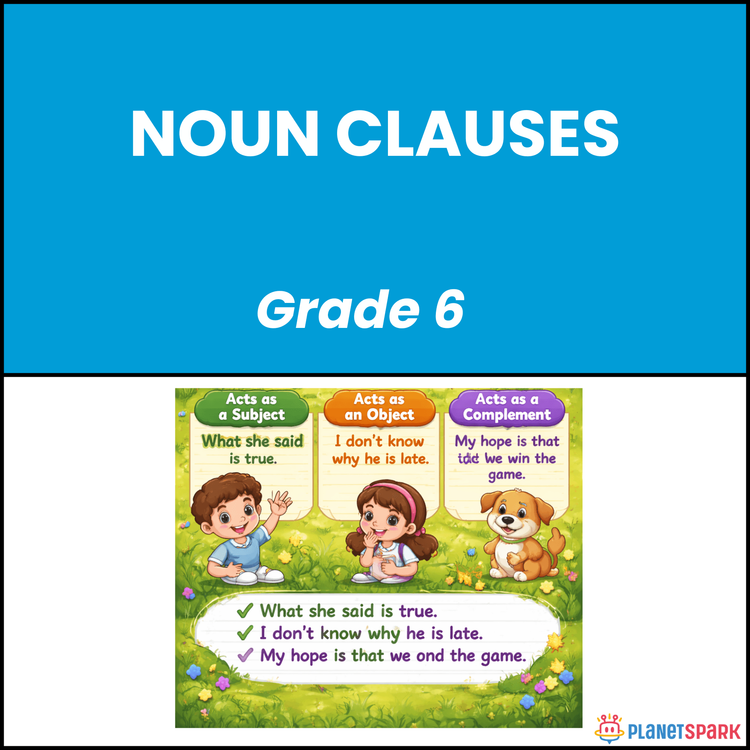
The worksheet includes tasks like underlining noun clauses, multiple-choice questions, sentence rewriting, and paragraph writing, allowing students to practice both recognition and construction of noun clauses. These exercises are designed to help students grasp how noun clauses function as subjects, objects, and complements in a sentence, and how they can add depth and detail to their writing.
By completing these activities, students will be able to enhance their writing and sentence construction skills. This worksheet is a perfect way to develop fluency in using noun clauses in both written and spoken English.
Master noun clauses and elevate your child's grammar skills with this comprehensive worksheet!
Book a free trial!
🔹 Answer Key
Exercise 1 – Underline the Noun Clause
1. that he is honest
2. why he left
3. where she lives
4. that we should leave
5. when we will arrive
6. what happened
7. What you said
8. that she is capable
9. that he left
10. why she was upset
Exercise 2 – Choose the Correct Noun Clause
1. a) that he is honest
2. a) What she said
3. a) why he left
4. a) when we will arrive
5. a) that he left
6. a) What you said
7. a) that she is capable
8. a) where she lives
9. a) why she was upset
10. a) that we should leave
Exercise 3 – Apply the Rule to Rewrite Each Sentence Correctly
1. She missed the meeting because she was late. (Simple Past Tense)
2. She doesn’t know where she is going. (Present Continuous Tense)
3. I will remember what she says. (Future Simple Tense)
4. We arrived when you were ready. (Simple Past Tense)
5. I understand why they did that. (Simple Present Tense)
6. He believed that she could do it. (Simple Past Tense)
7. Can you tell me where it is? (Future Simple Tense)
8. I don’t understand why they did that. (Simple Present Tense)
9. The teacher said that you passed the exam. (Simple Past Tense)
10. She didn’t know if she could make it. (Future Simple Tense)
Exercise 4 – Fill in the Blanks with Suitable Noun Clauses
1. what happened
2. where it is
3. why he left
4. when we will arrive
5. why she was upset
6. what you said
7. that she is capable
8. why they left early
9. that you passed the exam
10. if she could make it
Exercise 5 – Write a Short Paragraph Using Noun Clauses
(Answers will vary, sample: "I wonder why she left early, but she didn’t tell me the reason. I believe that she had an important meeting, but I am not sure. The teacher explained that she would return soon, but I am still wondering when that will be.")
Help your child master noun clauses today with a Free 1:1 Grammar Skills Trial Class at PlanetSpark.
Book a free trial!
🔹 FAQs
What are noun clauses, and why are they important for Grade 6 learners? Noun clauses function as subjects, objects, or complements in sentences, providing additional detail or meaning. For Grade 6 students, understanding noun clauses is crucial because:
1. They add depth and detail to sentences, making writing more engaging.
2. They help create more complex and varied sentence structures.
3. They are essential for forming advanced grammatical sentences in both writing and speaking.
How do the exercises in this worksheet help my child with noun clauses? The worksheet helps students identify noun clauses, choose the correct noun clause in sentences, and rewrite sentences using noun clauses in different tenses. These activities reinforce both recognition and application, making students more proficient at using noun clauses in their writing.
Why is practice with noun clauses important for my child's overall grammar development? Noun clauses are a key part of constructing more complex and meaningful sentences. Mastering them helps students write more fluently and clearly, making their essays and stories richer and more detailed. As they develop their grammar skills, they can express more sophisticated ideas effectively.
Frequently Asked Questions
A noun clause acts as a noun in a sentence, helping to add more detail or explanation.
Look for a group of words starting with words like "what," "who," or "that," which function as a noun.
They can be confused with other clauses or parts of speech, making identification tricky.